Addiction of course is not a new phenomenon, but social media addiction is a relatively new form of it. Although the DSM-5 does not consider social media addiction to be an official addiction in the same way as some substance-related disorders, this does not change what we observe every day in real life. The phenomenon is there.
Before we look at why EFT and Optimal EFT are such powerful tools when trying to deal with Social Media Addiction, let’s first understand the pattern behind addiction itself.
All addictions follow a similar pattern. In one way or another, they provide relief from underlying emotional patterns that exist within us. In different terms: When we experience anxiety, emptiness, loneliness, fear, separation or some other uncomfortable emotional state, we tend to look for something that can temporarily make us feel better.
Put simply, if we don’t know what Paradise is, and we feel separated from it, we create an artificial one in order to feel “heaven” for a while.
This artificial paradise can take many forms.
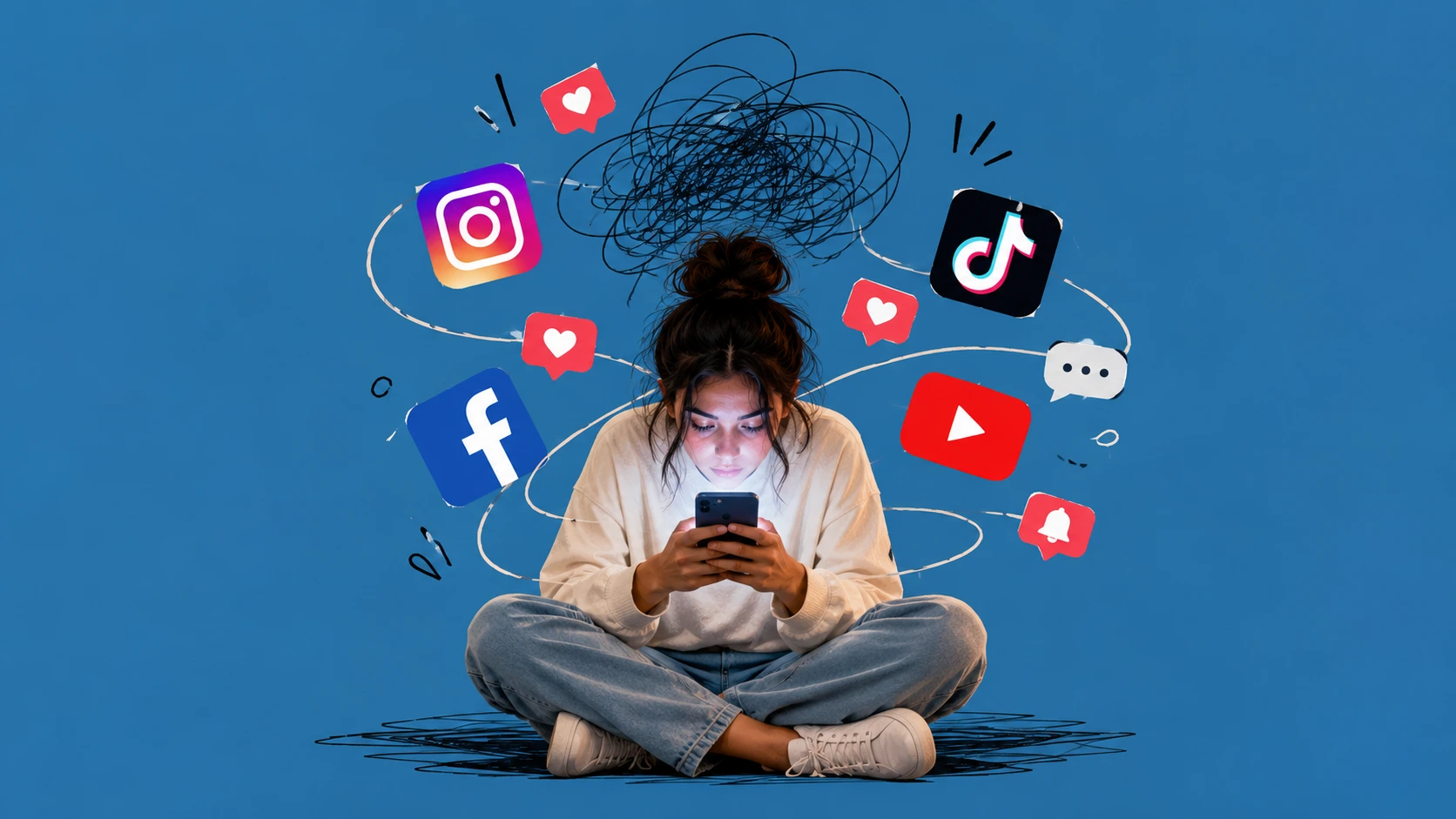
It can be food, alcohol, cigarettes, weed, drugs, porn, sex, gambling, shopping, or many other things. So now, we have another very powerful form of addiction: social media. Everywhere we look, we see people absorbed in their mobile phones, constantly checking notifications, messages, likes, comments and new posts.
But what exactly happens to us when we continuously enter this artificial world?
Let’s look at what happens when we scroll through social media from another perspective: from an energetic point of view. We are not just looking at something. We are also directing part of ourselves towards what we are looking at.
Where we focus, our energy goes.
Wherever we focus, we send our energy.
At the same time, in the opposite direction, energy comes into our system from the object being focused on. In other words, attention is not simply a passive process.
“I don’t know why, but I feel tired.”
When we scroll down on a social platform, we continuously send our energy toward the scenes, people and information that we are observing. At the same time, we are opening a door for all of these scenes and people to enter our subconscious mind.
We may not consciously decide that we want them to become part of us. We may not even remember most of what we have seen five minutes later. But the subconscious mind is receiving all these impressions. And the subconscious doesn’t forget.
What happens as a result?
Social Media affects us on three levels:
1. Attention/Energy
2. Conditioning/Influence
3. Relationship with reality and ourselves
A – We become energetically weaker
We become energetically weaker because we continuously send and lose energy through our attention. This is one reason why a person can spend their time just scrolling without doing anything physically demanding and still feel exhausted afterward. The body may have been sitting in the same position, but the mind has been continuously processing images, people, information, comparisons, emotions and stimuli.
B – We become increasingly open to influence and manipulation
We give permission to be hypnotized and manipulated. And this is even more serious.
When we continuously expose ourselves to the philosophy, images and messages of a platform, we give permission, consciously or subconsciously, to be influenced.
The platform has its own philosophy. It has its own mechanisms for keeping our attention, and it learns what attracts us and gives us more of it.
We may believe that we are freely choosing what to watch, but at the same time the platform is continuously presenting me with new things to look at.
This creates a type of hypnotic state.
We scroll/see something.
We react/scroll again.
We see something else.
We react again.
And the process continues.
All of these things happen simultaneously and mostly subconsciously, without us understanding what is happening. We may simply notice the final result: feeling tired, small, lonely, anxious, dissatisfied or empty, without connecting these feelings with the hundreds of images and messages that just entered our mind.
C – We gradually begin to live in another, artificial world
The third problem is that we gradually begin to live in another, artificial world.
Instead of experiencing life directly, we experience a representation of life through a screen. We see other people’s homes, relationships, bodies, holidays, success, money, opinions, achievements and lifestyles. We compare our real life with the edited version of somebody else’s life.
This creates another form of separation.
The more we live through this artificial world, the less connected we are with the real world in front of us. The result may be solitude, loss of logical thinking, loss of the will to resist, depression and an increasing feeling of separation. We may have an infinite number of online connections and still feel lonely and separated from other people and life in general.
Healing addiction with EFT and Optimal EFT
We can manage social media addiction in the same way that we manage any other addiction. The important point is to understand that the addictive behaviour itself is not the real problem. It is a way of soothing or escaping from underlying emotional patterns, especially anxiety patterns.
So if the addictive behaviour is not the root of the problem, but a way of regulating or escaping from an underlying emotional state, simply trying to stop the behaviour does not address the root.
Therefore, the first step is to resolve these underlying emotional patterns with EFT.
By working on any uncomfortable emotions that are driving addictive behaviour, such as anxiety, fear, loneliness, or emptiness with EFT / OEFT, the need to escape becomes weaker. Which means that we no longer need social media to regulate our emotions as we did before.
This is a very effective approach to deal with addiction. Otherwise, we would be trying to stop the addiction through willpower only.
We would say to ourselves:
“I will not scroll anymore.”
“I will put my phone away.”
“I will stop checking social media.”
But as long as the emotional pattern underneath the addiction is still there, we would have to use a great deal of willpower to resist it. Sooner or later, when being tired, anxious or emotionally vulnerable, the old behaviour might return.
When, on the other hand, we resolve the underlying emotional patterns with EFT, we will need much less willpower to keep the new, healthier habit.
This is the first part of healing: resolving the emotional patterns that make us want to escape.
But there is a second part.
And this part is about discovering what we are actually trying to find through the addiction.
When we look at addiction from this perspective, we can see that we are not simply trying to get away from something. We are also trying to get somewhere.
We are looking for relief. We are looking for comfort. We are looking for connection, happiness, stimulation, or a feeling that something is missing inside us is finally being filled.
The problem is that we often try to find these things outside ourselves. We use social media to create moments of pleasure, distraction, connection or excitement. But when the stimulation ends, the underlying feeling is still there. So we return to the phone and look for another moment of relief.
This can create a cycle:
We feel uncomfortable.
We reach for social media.
We receive stimulation.
We feel better for a while.
The stimulation fades.
The uncomfortable feeling returns.
And we reach for social media again.
The second part of healing is about stepping out of this cycle by discovering a different source of happiness.
Instead of constantly looking outside ourselves for something that will make us feel complete, we begin to discover what is already available within us.
This is where the Unseen Therapist comes in
The Unseen Therapist is our true self, the deeper part of ourselves. By reestablishing this connection, we begin to discover a source of happiness that does not depend on external stimulation.
This does not mean that we can never enjoy social media, entertainment, food, relationships or other experiences. The point is that we no longer need these things to escape from ourselves or to temporarily fill an inner emptiness.
We can enjoy something without becoming dependent on it.
We can use social media without needing it to regulate every uncomfortable emotion.
And perhaps most importantly, we can begin to experience the present moment directly again.
Then the addiction gradually loses its purpose.
The more we reconnect with our true self, the less we need to escape from ourselves
We discover that what we were looking for through the addiction was not really the phone, the screen, the notifications or the endless stream of content. Instead, we were looking for a feeling, for relief, for connection, for happiness.
When we begin to discover these things within ourselves, the need to constantly search for them outside ourselves becomes weaker. Because there always is another choice.
The choice to return to ourselves.